Ecosystem marketing is having a moment. I’m seeing the term pop up more and more in SaaS marketing conversations, in newsletters, on podcasts, in job descriptions. Which is great, because I think it’s one of the most important strategic shifts a SaaS company can make. But the problem with any term that gains traction is that people start applying it to things it doesn’t describe.
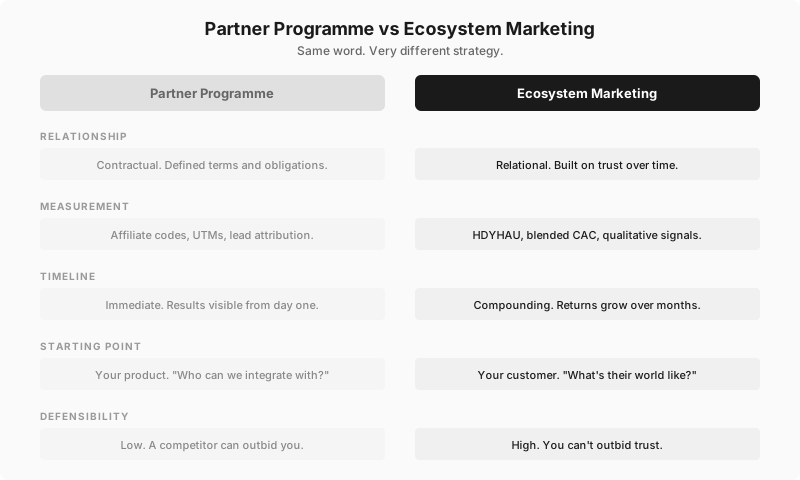
Most companies I see claiming to do ecosystem marketing are actually just doing partner marketing with a new label. They have affiliate programmes, co-marketing agreements, maybe some integrations with complementary tools. They’ve put all of that under an “ecosystem” umbrella and called it a strategy. It isn’t one. At least not in the way that makes ecosystem marketing valuable.
I’ve written a complete guide to ecosystem marketing that covers the full framework, but this post is about something more specific: how to tell if you’re actually doing ecosystem marketing or if you’ve just renamed your partnerships page.
The litmus test
If a marketing director told me their company does ecosystem marketing, I’d ask them two questions.
The first: tell me about your customer’s world. Not your product. Not your integrations. Your customer’s world. What events do they go to? What communities are they active in? Who do they trust for advice? What content do they consume? What other tools sit alongside yours in their daily workflow?
If they can’t answer that with specifics, they don’t have an ecosystem strategy. They might have partners, but they don’t have an ecosystem. Because an ecosystem strategy starts with a deep understanding of the customer’s orbit, not your own product’s orbit. The two overlap, but they’re not the same thing.
At Narrative, our marketing team ran customer interviews regularly. Not just for product feedback, but to understand how professional photographers actually moved through their world. What conferences mattered to them. Which educators they followed. Where they hung out online. Which Facebook groups they trusted. That understanding became the foundation for everything we did in ecosystem marketing. Without it, we would have been guessing.
The second question I’d ask: how are you connecting these activities together and measuring the whole thing? Because ecosystem marketing isn’t a collection of disconnected tactics. It’s not “we sponsor an event AND we have affiliates AND we’re in a Slack community.” Those are ingredients. The strategy is how they work together, how each reinforces the others, and how you know if the sum is greater than the parts.
If the answer is “we track affiliate codes and event leads separately in different spreadsheets,” that’s not ecosystem marketing. That’s a list of marketing activities.
Why companies default to partnerships instead
Real ecosystem marketing is hard. Not conceptually hard. Execution hard. And the difficulty isn’t in any single activity, it’s in the patience and consistency required to make it work.
Partner marketing is attractive because it’s structured and measurable from day one. You sign an agreement, you set up tracking, you can see the numbers in a dashboard. The feedback loop is tight. You know what you’re getting.
Ecosystem marketing doesn’t work like that. The returns are real, but they compound over time rather than showing up immediately. You invest in showing up at events, building relationships with creators, being present in communities, co-creating content with people in your niche. And for the first few months, it can feel like nothing is happening. The numbers don’t move in the ways your board deck wants them to.
I dealt with this tension directly at Narrative. Our founder would sometimes look at the team being out at trade shows and community events and say things like “the team aren’t working.” And I get it. When you’re used to measuring marketing by leads generated per hour, a team spending three days at a conference building relationships looks like a holiday.
My response was always the same: this is work. We’ve looked at the data, we’ve assessed our channels, and we’ve acknowledged that this is the most impactful thing we can be doing. That’s why the team is doing it. The fact that it doesn’t look like sitting at a desk running ads doesn’t make it less productive. It makes it differently productive.
That conversation is one that every marketing leader doing ecosystem work needs to be prepared to have. If you can’t make the case internally for why relationship-building activities are strategic investments rather than nice-to-haves, the programme will get cut the moment someone looks at the budget.
The partnership trap
Here’s where the relabelling gets dangerous. When a company calls its partner programme “ecosystem marketing,” it creates a false sense of strategic sophistication. The team thinks they’re doing something forward-thinking. Leadership thinks the box is ticked. But the actual approach hasn’t changed.
Real ecosystem marketing requires you to invest in relationships and activities where the ROI isn’t immediately attributable. A photo walk with photographers in your community. A dinner with educators who influence your target audience. Showing up at an industry event not to sell, but to be seen and to listen. These activities don’t have a line item in your attribution model.
Partner marketing keeps everything within a measurable, contractual framework. Ecosystem marketing asks you to step outside that framework and trust that consistent investment in your broader market will pay off. That’s a different kind of confidence, and it’s one that most SaaS marketing teams haven’t built yet.
What actual ecosystem marketing looks like
Rather than define it abstractly, here are some signals that distinguish real ecosystem marketing from rebranded partnerships.
You know your customer’s world better than your competitors do. You can name the five events they attend, the ten creators they follow, the communities where they ask for advice. And you got that knowledge from talking to them directly, not from a market research report.
Your activities reinforce each other. The creator you work with also speaks at the event you sponsor. The community you’re active in shares the content your ambassadors create. The partner whose product complements yours co-hosts meetups with you. None of these connections are coincidental. You built them intentionally.
You show up where you’re not selling. You’re present in communities and at events where you’re not running a booth or giving a pitch. You’re there to contribute, to listen, to be part of the conversation. The selling happens later, and often it happens because someone else recommends you.
You have a way to measure the whole, not just the parts. Maybe it’s HDYHAU tracking on your signup flow. Maybe it’s blended CAC trending downward over time. Maybe it’s qualitative signals like inbound partnership requests increasing. But you’re looking at the ecosystem as a system, not as isolated tactics.
You can survive the “this doesn’t look like work” conversation. When someone questions why your team is at a trade show or a community dinner instead of running campaigns, you have the data and the conviction to explain why.
The uncomfortable truth
Most SaaS companies aren’t ready for ecosystem marketing. Not because they lack the budget or the team, but because they lack the patience. Ecosystem marketing is a long game. The compounding returns are real, and they’re significant, but they take months to become visible. In a world where marketing teams are measured quarterly and CMO tenure keeps shrinking, investing in something that won’t show clear results for six months is a tough sell.
That’s why so many companies default to calling their partnership programme an ecosystem and moving on. It’s easier. It fits in a spreadsheet. It makes the quarterly review less uncomfortable.
But the companies that actually commit to building an ecosystem, that invest the time, that show up consistently, that build real relationships rather than contractual ones, end up with something their competitors can’t replicate. A partnership can be outbid. An ecosystem can’t.
If you want to go deeper on how to actually build one, I’ve written the complete guide here. But the starting point is simple: know your customer’s world. Then show up in it.