At Narrative, my team ran what most people would call both partner marketing and influencer marketing. But internally, we never really thought about it that way. We thought about it in tiers: what’s the relationship, what’s the expectation, and what are we actually trying to achieve with this person or brand? The labels came later, usually when someone outside the company asked what we were doing.
The problem with the labels is that people use them interchangeably. Or they think one is a subset of the other. Or they assume influencer marketing is just partner marketing but with creators instead of companies. None of that is right, and the confusion leads to misallocated budgets and programmes that don’t deliver because they were designed with the wrong model in mind.
How most people define these (and why it falls short)
The textbook definitions are simple enough. Partner marketing is a formal arrangement between two companies for mutual commercial benefit. Revenue share, co-marketing, integrations, marketplace listings. Influencer marketing is paying an individual with an audience to promote your product.
Those definitions aren’t wrong, but they’re incomplete. They describe the mechanics without capturing what actually makes each approach work or fail. And in practice, especially in B2B and prosumer SaaS, the lines blur in ways the textbooks don’t account for.
At Narrative, we had relationships that looked like partnerships on paper but functioned more like influencer relationships in practice. And we had creators who started as paid promoters but evolved into something closer to strategic partners over time. The structure of the deal matters less than the intent behind it and how the relationship actually plays out.
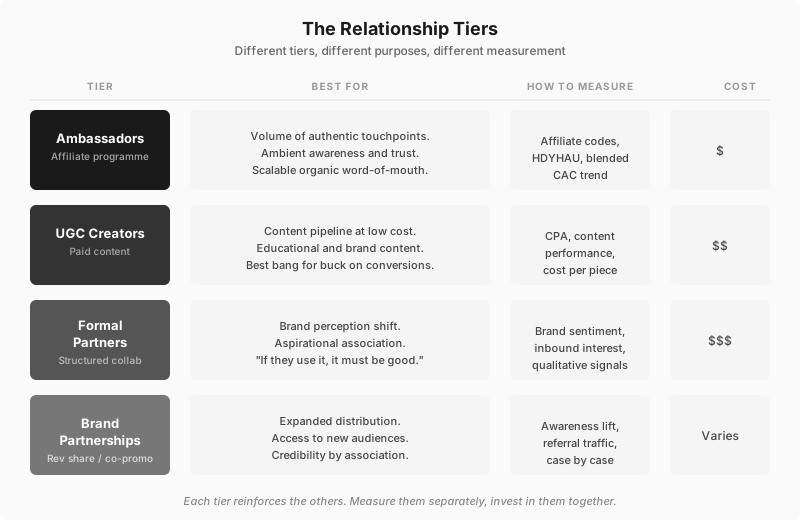
What we actually built at Narrative
Rather than using the industry labels, we structured our creator and partner relationships into tiers based on what we were trying to achieve.
Ambassadors
This was the broadest tier. Ambassadors were photographers who loved the product, used it in their actual workflow, and were happy to recommend it. We ran an affiliate programme where they’d earn a percentage of paid conversions they drove. Before I joined, the model paid a flat fee per signup, even free ones under the freemium model. When we moved away from freemium, we shifted to a percentage of paid conversions, which felt fairer to everyone.
The important thing about ambassadors was authenticity. They had to be real users. We could see whether they were actually using the product, and if someone signed up for the affiliate programme but never opened the app, that relationship wasn’t going to work. The whole point was that their recommendation carried weight because it was real.
Ambassadors were a volume play. Lots of people, each with their own audience, each creating organic touchpoints. No single ambassador was going to transform the business, but collectively they created a layer of ambient awareness and trust that you can’t replicate with ads.
Formal partners
A step up from ambassadors, these were photographers we’d approach for a more structured collaboration. The bar was higher. They had to be at the top of their game, doing aspirational work, the kind of photographer other photographers look up to. And they had to be genuine users who represented the brand well.
With formal partners, we’d agree on a set of expectations for a defined period. Content deliverables, event appearances, that kind of thing. It was more like a traditional sponsorship in structure, but the relationship still had to feel authentic. If someone didn’t actually use Narrative in their workflow, the partnership didn’t happen regardless of their audience size.
Here’s something we learned that surprised us: these bigger formal partners didn’t always drive the best results in terms of online content performance. Their YouTube videos or Instagram posts might not convert as well as content from smaller creators. But that wasn’t really their purpose. They influenced in different ways. When a photographer who’s building momentum in the education space, getting asked to speak at major conferences, and shooting for high-profile clients is publicly associated with your brand, that changes how the entire market perceives you. It’s aspirational. It’s “if they use it, it must be good.”
The ROI on these partnerships is hard to measure directly, and that’s where a lot of companies go wrong. They evaluate formal partners with the same metrics they use for affiliate creators and then conclude the partnership “isn’t working” because the affiliate numbers don’t stack up. Different tier, different purpose, different measurement.
UGC creators
This was a separate track entirely. UGC creators might have smaller followings, but they could create content that performed well and cost a fraction of what the bigger formal partners cost. Some of it was brand awareness style content, some of it was educational, showing how to use the product in different workflows.
The bang for buck on UGC was often better than the formal partners when you measured it purely on content performance and cost per conversion. We found that scaling lots of smaller pieces of UGC content could have a really strong cumulative impact. Each piece was cheap, each piece reached a relevant niche audience, and collectively they built a steady drumbeat of visibility.
The other thing we did with UGC was feed the best-performing pieces into our paid strategy. When a creator’s content took off organically, we’d turn it into an ad and compare the CPA against our best in-house creative. The creator content almost always won because it felt native rather than like an ad. So UGC wasn’t just an organic play for us, it was also a creative pipeline for paid.
Brand and marketplace partnerships
Then we had a different category altogether: partnerships with other brands in the photography ecosystem. Revenue share models, marketplace placements, co-promotional arrangements. These were more traditional B2B partnerships, negotiated case by case.
The dynamic with brand partnerships was different from creator relationships. When someone visits another brand’s marketplace, they’re in that brand’s world. They’re expecting to buy that brand’s products. Your product being listed there might create awareness, but the context isn’t ideal for conversion. You have to find creative ways to make these partnerships work rather than expecting them to function like a direct acquisition channel.
I think the key with brand partnerships is expectation management. They’re better for awareness and credibility than for direct conversion. If you go in expecting affiliate-level attribution, you’ll be disappointed. If you think of them as another node in your broader ecosystem marketing strategy, they make a lot more sense.
The real difference
So what’s actually the difference between partner marketing and influencer marketing? After building a team that ran both at Narrative, here’s how I’d frame it.
Partner marketing is structural. It’s defined by agreements, terms, deliverables, and measurement frameworks. The value exchange is explicit. Both parties know what they’re getting and what they’re giving. It works well when the commercial logic is clear and both sides can track outcomes.
Influencer marketing, when done well, is relational. Yes, there’s often a financial arrangement, but the best creator relationships aren’t primarily about the transaction. They’re about someone who already uses and believes in your product sharing that with their audience in a way that feels natural. The value isn’t just in the content they create or the clicks they drive. It’s in the trust they transfer.
The confusion happens because companies try to run influencer relationships with a partner marketing mindset. They create rigid contracts, define exact deliverables, measure everything through affiliate codes, and then wonder why it feels transactional and the content underperforms. Or they try to run brand partnerships with an influencer marketing mindset, expecting that a marketplace listing will drive the same kind of warm, trust-based conversions that a creator recommendation does.
When to use which
If I were advising a SaaS company on how to think about this, I’d start with what you’re trying to achieve.
If you need direct, measurable conversions and you have a product that lends itself to demonstration, build an ambassador and UGC programme. Volume of authentic touchpoints, reasonable cost per conversion, scalable.
If you need to shift market perception and build aspirational brand association, invest in a smaller number of formal partnerships with people at the top of the industry. Don’t measure them on affiliate codes. Measure them on brand sentiment, inbound interest, and the quality of conversations happening about your brand.
If you need to expand distribution and access new audiences at the company level, explore brand partnerships and marketplace placements. Go in with awareness expectations rather than conversion expectations.
And if you’re serious about long-term growth, do all of them. But understand that they work differently, they compound differently, and they need to be measured differently. Lumping them all under “partner marketing” or “influencer marketing” and applying a single measurement framework is the fastest way to misread your data and make bad investment decisions.
The best programmes I’ve seen, including the one we built at Narrative, treat these as layers that reinforce each other. Your ambassadors create the volume. Your formal partners create the aspiration. Your UGC creators fill the content pipeline. Your brand partnerships expand your reach. And the ecosystem they create together is worth more than any individual layer on its own.