Most SaaS companies treat events like isolated campaigns. You book the booth, fly the team over, collect badge scans, send a follow-up email, then move on to the next thing. That approach can work if your goal is just to create a burst of activity for a week. It does very little if what you actually want is long-term brand momentum inside a niche market.
The better way to think about events is as anchors for community loops. The event itself matters, but not as a standalone tactic. It matters because it gives you a moment where customers, creators, educators, partners, and your own team all end up in the same place at the same time. If you use that moment well, one event can create introductions, content, referrals, and relationships that keep paying off for months afterwards.
That’s what we learned at Narrative. Some of our best event outcomes had very little to do with the leads we captured at the booth that week. The bigger value came from what happened around the event: the conversations before it, the smaller community gatherings during it, and the follow-up work that turned warm interactions into ongoing relationships. That’s the part I think most SaaS teams miss.
Why most event strategies underperform
The default SaaS event playbook is built for attribution, not for trust.
Leadership wants to know how many leads came from the event. The team wants to justify the travel budget. So everything gets optimised around what is easiest to count: badge scans, booked demos, meetings taken, pipeline created within 30 days.
None of those metrics are useless. But they create a very narrow view of what events are good for, especially in niche markets where reputation and recommendations matter more than high-volume lead capture.
At Narrative, our target market was professional photographers. That’s a world where people talk to each other constantly. They notice who is showing up. They notice which educators use which tools. They notice who is sponsoring what, who is present, and who understands the culture. In that kind of market, the commercial value of an event isn’t just the people who visit your booth. It’s the broader signal you send by how you show up and who you spend time with.
I’ve written before about what ecosystem marketing actually means. Events are one of the clearest places where you can see the difference between an ecosystem approach and a standard campaign approach. A campaign asks, “what did this event generate?” An ecosystem approach asks, “what relationships did this event strengthen, and what can those relationships generate next?”
The loop to build instead
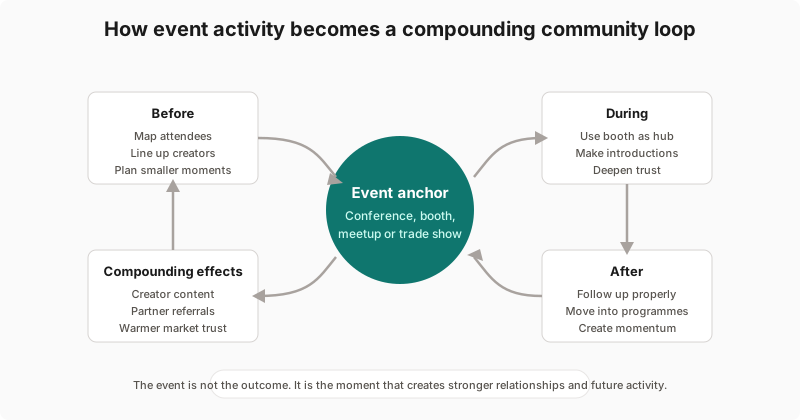
The simplest way to think about this is as a three-part loop: before, during, and after.
Before the event
Most teams leave too much value on the table before they even get on the plane.
The weeks before an event should be about mapping who matters in that specific moment. Which customers are attending? Which creators or educators will be there? Which complementary brands will be in-market at the same time? Which existing ambassadors can you bring closer into the fold?
At Narrative, this was often where the real work started. The event itself gave us a reason to pull people together, but the value came from being deliberate in advance. We’d think about who should meet who. Which photographers we wanted our team to spend proper time with. Which creators might be a fit for the ambassador programme. Which partner brands could be useful collaborators in the same orbit.
This is also the stage where smaller community moments get planned. Not giant branded productions. Intimate things. A photo walk. A dinner with a few educators. A meetup that feels like it belongs to the community rather than to your company. Those are often the interactions people remember most.
During the event
During the event, your booth should act as a hub, not the whole strategy.
Narrative did invest heavily in trade show presence because our product demoed well. People could sit down, understand the value quickly, and often convert fast. That mattered. But the booth worked best when it was one node in a broader set of interactions.
The most valuable thing an event gives you is concentration. Everyone is there. That means you can create density in your relationships if you use your time properly. One strong event can help you deepen partner relationships, progress creator conversations, strengthen community trust, and get customers talking to each other.
Some of the best things we did were the least corporate. Smaller gatherings, more informal moments, more time spent actually talking to people rather than rushing to the next lead. We found that when people had a real experience with the team, not just a transactional booth interaction, the relationship warmed up much faster.
That matters because community trust does not build through polished event marketing alone. It builds when people feel like you’re genuinely part of their world.
After the event
This is where most of the compounding value either gets captured or wasted.
If all you do after an event is send a generic follow-up email to everyone you scanned, you’ve basically reduced the whole experience to a database exercise. The better move is to think about what each promising relationship needs next.
Some people need a direct follow-up and a clearer next step. Some should be introduced to a partner or creator you met at the same event. Some are obvious candidates for an ambassador or content relationship. Some should be pulled into a customer feedback conversation while the interaction is still fresh.
The event creates the initial heat. The follow-up turns that heat into momentum.
This is where community and creator loops start to form. A photographer you spent time with at an event later posts about your product. Someone in their audience sees it and asks about it in a Facebook group. Another creator sees that conversation and reaches out. A partner invites you into something else because they saw how you showed up in person. None of that appears neatly in the event report. But it’s often the highest-value outcome.
What this looked like at Narrative
At Narrative, the major photography events became anchors for a lot more than event marketing.
Yes, we had the booth. And yes, the booth mattered. We put real thought into making it visually distinctive, easy to engage with, and strong for live demos. But the bigger opportunity was what happened around those events.
We’d organise smaller community experiences that felt like they belonged to photographers rather than to a software brand. Photo walks worked especially well because they matched the culture of the market. People could spend time together doing something natural to them, not just standing around in a branded space making polite conversation.
We also used events to deepen ambassador relationships. Rather than treating those people like rented media, we tried to make them feel like insiders. That might mean bringing a group together for something memorable and social, then dropping into a partner event afterwards so different parts of the ecosystem were mixing in the same night. Done well, that creates far more long-term value than another formal dinner with a logo on the menu.
The reason this worked is that it created multiple forms of connection at once. Our team got closer to creators. Creators got closer to each other. Partners saw that we could bring good people into the room. Customers saw that we were actually part of the photography world rather than sitting outside it trying to sell into it.
That’s the loop. One event creates a cluster of stronger relationships. Those stronger relationships create more visibility, more referrals, and more trust long after the event ends.
Don’t optimise for badge scans alone
If you only judge events by direct lead capture, you’ll underinvest in the things that make them powerful.
I’m not saying don’t track pipeline. You should. But I would look at a broader set of signals:
- Did the event create new creator or ambassador relationships?
- Did existing partners get stronger?
- Did you generate introductions that wouldn’t have happened otherwise?
- Did branded search or HDYHAU mentions lift in the weeks after?
- Did any content, referrals, or collaborations come out of the people you spent time with there?
- Did the market feel warmer towards you afterwards?
That last one sounds soft, but it matters. In a niche market, people can feel when a brand is becoming more embedded in the community. You hear it in conversations. You see it in who starts mentioning you unprompted. You notice that prospects arrive already trusting you more.
That’s also why I keep coming back to measurement. Traditional attribution will rarely give events full credit for what they actually do. You need HDYHAU data, qualitative feedback, and a longer time horizon if you want to see the whole picture.
Build an operating rhythm, not a one-off event plan
The easiest way to make events more valuable is to stop treating them as isolated moments.
What works better is a repeatable rhythm:
Four to six weeks before: map attendees, line up meetings, identify creators and partners worth spending time with, plan one or two smaller community moments.
During the event: use the booth as a meeting point, but prioritise real conversations and ecosystem introductions. Make sure someone on the team owns relationship-building, not just lead capture.
Within one week after: send thoughtful follow-ups, make introductions, log who matters, and identify who should move into your creator, partner, or community workflows.
Within 30 days after: look for the second-order effects. Content published. Referrals made. Warm conversations continuing. Signals in HDYHAU. Brand mentions in community spaces.
Once you do this a few times, the whole thing gets easier. Your existing ambassadors start introducing you to the next layer of people. Partners want to collaborate again because the last event was useful for them too. Customers arrive at the next event already knowing people you brought together at the last one.
That’s when the loop starts compounding.
Common mistakes
There are a few mistakes I see repeatedly.
Mistaking a party for a strategy. Community events work because they strengthen relationships. If the event is just a flashy expense with no thought behind who is there and why, it’s not a loop. It’s just a cost.
Only talking to prospects. Some of the highest-value conversations at an event are with creators, educators, partners, and existing customers. If your team is trained to chase only net-new leads, you’ll miss half the opportunity.
Not assigning ownership. Relationship-building needs an owner. At Narrative, one of the reasons our creator work improved was that we had specific people responsible for it. The same principle applies at events. If nobody owns follow-up, the momentum disappears fast.
Expecting instant proof. Event loops are part of a broader ecosystem strategy. They work through compounding trust, not just immediate conversion. If leadership expects a clean same-week ROI story every time, you’ll end up optimising for the least interesting outcomes.
What good looks like
Good event marketing in a niche SaaS category should leave the market warmer than it found it.
People should come away feeling like your brand is more present, more connected, and more embedded in their world. Your creators should feel closer to you. Your partners should feel like working with you creates energy, not admin. Your customers should feel like you understand the culture they belong to.
If that happens consistently, the direct event ROI becomes almost the least interesting part. The real win is that each event makes the next one more valuable. More people know you, more people trust you, and more parts of the market start reinforcing each other.
That’s why I think the best events are not really events at all. They’re catalysts. The booth, the meetup, the dinner, the photo walk, the partner introduction. They’re all just ways of getting the right people into the same orbit and giving the relationship somewhere to go next.
Do that well and you stop running events as campaigns. You start using them as community infrastructure.