The first thing most B2B companies get wrong about influencer marketing is assuming it works like B2C. Find someone with a big audience, pay them to talk about your product, measure clicks and conversions. It sounds logical. It almost never works.
I’ve seen this from both sides. At Poliigon, I worked alongside BlenderGuru — one of the biggest creators in the 3D space — helping figure out what content actually moved the needle for the business. At Narrative, I built and led a marketing team that ran creator and ambassador programmes across hundreds of photographers. Some of those relationships were textbook B2B influencer marketing, even if we didn’t always call it that.
The companies I see getting results from B2B influencer marketing in 2026 aren’t running the B2C playbook with a different audience. They’re doing three things differently: picking the right people, briefing them properly, and measuring impact in ways that actually reflect how B2B buying decisions happen.
You’re probably picking the wrong people
The most common mistake is chasing follower count. It makes intuitive sense — bigger audience, more exposure, more leads. But in B2B, reach is almost irrelevant compared to relevance.
At Narrative, our best-performing creators weren’t the ones with the biggest followings. They were photographers with 10,000–30,000 followers (sometimes smaller) who happened to be deeply embedded in the specific community we were trying to reach. Their audiences were almost entirely professional and semi-professional photographers — exactly our target customer. When they recommended a tool, people listened, because the recommendation came from someone who actually did the same work they did.
Compare that to a creator with 500,000 followers. That number might look great in a report, but you have to ask why they have that audience. If their most popular content is trending audio remixes or comedy skits that went viral, their following isn’t built on the expertise you need them to transfer to your brand. The audience composition is wrong, and the engagement that matters — comments and discussion around the topics relevant to your product — probably isn’t there.
This is where a lot of companies skip a step. Before you partner with anyone, look at their engagement rates on topic-relevant content specifically. Not their overall engagement rate, not the numbers on their most viral post. Look at what happens when they post about the subject area your product lives in. If their tutorial content gets strong engagement from the right people but their dancing reels get 10x the views, that’s fine — you care about the tutorial audience, not the reel audience. But if they don’t have engagement on relevant content at all, the follower count is meaningless.
In B2B, the question isn’t “how many people will see this?” It’s “how many of the right people trust this person’s opinion on this specific topic?” Those are very different questions, and they lead you to very different creators.
This applies to thought leaders too, not just content creators. At Narrative, some of our most valuable relationships were with photographers who were building momentum in the education space, speaking at conferences, and shooting for high-profile clients. They weren’t “influencers” in the traditional sense. But when they publicly used our product, it shifted how the market perceived us. That’s B2B influence at its most powerful — it’s not about clicks, it’s about credibility transfer.
The briefing problem nobody talks about
Even when you find the right person, most B2B influencer campaigns underperform because the brief is wrong. And by wrong, I don’t mean poorly written. I mean structurally misaligned.
Here’s a real example, during a major sale month, we set up a competition for our creators and ambassadors. The structure was simple: whoever drove the most signups that month would earn triple commission, second place got double, third got 1.5x. We wanted a flood of leads coming through so we could convert them during the sale.
The problem was that our creators had learned — correctly — that pushing a “sign up for free” message was what worked best with their audiences. Free is an easy sell. Their audiences responded to it. So that’s what they promoted.
But we needed them to talk about the sale. We were running a major discount, and the whole point of the competition was to drive revenue during that window. The creators weren’t incentivised to push the sale message — they were incentivised to push the free message, because that’s what got signups, and signups were what the competition measured.
The result was friction. The sale messaging didn’t land the way it should have. The creators felt pulled in two directions. The campaign performed alright but could have gone so much better had we built an incentive structure that aligned with our actual business goal.
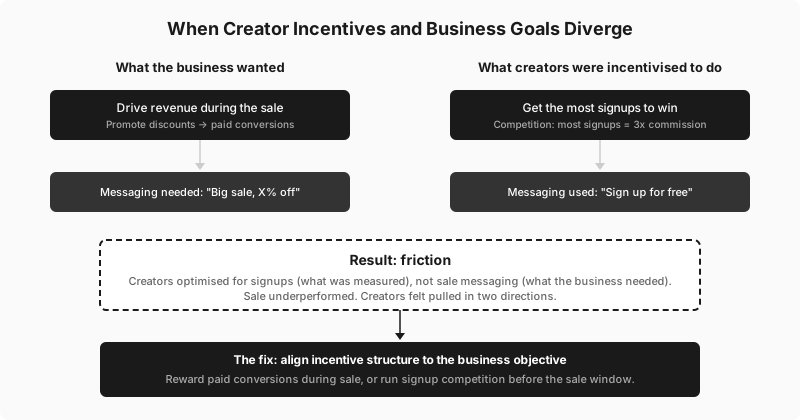
If we’d run it again, we’d have restructured the competition to reward paid conversions during the sale period rather than raw signups. Or we’d have run the signup-focused competition before the sale to build the audience, then shifted messaging for the sale itself.
And this kind of misalignment shows up in different ways depending on the business. At Poliigon, we were targeting 3D creators across multiple verticals — architects, game designers, VFX artists. The briefing challenge there was that a creator who’s huge in the architectural visualisation space might have zero crossover with the game design audience, even though both use 3D assets. If you brief them broadly on “3D textures,” the message doesn’t land with anyone specifically. You need to match the creator’s niche to the vertical you’re trying to reach and brief them accordingly.
At BetterSaver, the challenge was different again. We were trying to reach people at a specific life stage — young enough to benefit from switching KiwiSaver providers, engaged enough with their finances to care. The creators we worked with needed audiences that skewed toward that age and intent profile. A personal finance creator with an older, already-retired audience wasn’t going to move the needle, even if their content was excellent. The brief had to account for who the creator’s audience actually was, not just what the creator talked about. And we were tight on our feedback loops there — we had HDYHAU tracking on signups, we monitored CAC across channels, and we built a pretty sophisticated process for understanding which campaigns and marketing work was actually driving results. That kind of rigour meant we could course-correct quickly when a brief or a creator partnership wasn’t landing.
The lesson across all of these is the same: your brief and incentive structure need to point in the same direction as your business objective. When they don’t, even good creators with the right audience will produce the wrong outcome.
This is something I see constantly in B2B influencer marketing. Companies brief creators on what to say without thinking about whether the incentive structure supports that message. Or they give creators total creative freedom without aligning on what success looks like for the business. Both approaches lead to campaigns that feel productive but don’t move the metrics that matter.
Measurement needs to match the buying cycle
The third thing most B2B companies get wrong is measurement, and I’ve written about this in detail. But it’s worth repeating in the B2B context because the gap between how influence works and how it’s measured is even wider here.
B2B buying cycles are long. Someone sees a creator mention your product, they might not act on it for weeks or months. When they do, they’ll probably Google your brand name, visit your site directly, maybe book a demo. Your analytics will attribute that to “direct” or “organic search.” The creator who planted the seed gets zero credit.
I’ve used HDYHAU (How Did You Hear About Us) tracking at both BetterSaver and Narrative, and at both companies it was the single most valuable thing we did for understanding what was actually driving growth. Without it, you look at your dashboard and conclude that organic search and direct traffic are doing all the heavy lifting. With it, you can see that creators, community, and word of mouth are driving a massive chunk of signups that traditional attribution completely misses. At BetterSaver we built tight feedback loops around this — tracking CAC by channel, monitoring campaign effectiveness in near real-time, and using that data to shift budget quickly. At Narrative we did the same with our creator programme, cross-referencing HDYHAU responses against creator content launches to understand the real impact.
If you’re trying to model that more honestly, I built a creator marketing ROI calculator that combines direct attributed customers with creator-influenced HDYHAU signups so you can see a more realistic blended number.
If you’re running B2B influencer marketing and only tracking affiliate codes or UTM links, you’re measuring maybe 20% of the actual impact. The other 80% is showing up as “direct” traffic and you’re crediting it to your brand rather than the creators who built the awareness in the first place.
What good B2B influencer marketing looks like
Based on what I’ve seen work — both at Narrative and watching how other B2B companies approach this — here’s what I’d focus on.
Pick for relevance, not reach. Find people who are actually embedded in the community you’re trying to reach. In B2B, a creator with 5,000 followers in exactly your niche is worth more than someone with 200,000 followers in an adjacent space. Look at who your best customers follow and trust, not who has the biggest numbers.
Align incentives before you brief. Before you write a single word of a brief, make sure your incentive structure supports your actual business goal. If you want paid conversions, reward paid conversions. If you want awareness, reward reach and engagement. Don’t reward one thing and expect another — creators will optimise for whatever you’re measuring, and they should.
Let creators be creators. The worst B2B influencer content is the stuff that reads like a press release delivered by someone with a following. Your creators know their audience better than you do. Give them the key messages, align on the goal, then let them figure out how to land it in a way that’s authentic to their style. The content will perform better and the relationship will last longer.
Measure the full picture. Set up HDYHAU tracking. Monitor your blended CAC month-on-month. Watch for lifts in branded search volume after creator content goes live. Track whether customers who come via creator influence retain better and have higher LTV. Don’t just stare at affiliate dashboards.
Think long-term. The best B2B influencer relationships aren’t campaigns. They’re ongoing partnerships where a creator becomes closely associated with your brand over time. That association compounds. Every piece of content they create, every conference they speak at, every conversation they have builds another layer of credibility for your product. Cycling through creators to chase first-time spikes is a trap I’ve written about before — it’s even more costly in B2B where trust takes longer to build.
It’s ecosystem, not campaign
The companies doing B2B influencer marketing well in 2026 aren’t thinking about it as a standalone channel. They’re thinking about it as one layer in a broader ecosystem marketing strategy. Creators, partners, community, content, events — they all reinforce each other.
A creator mentions your product. Someone in a community group asks about it. A partner lists you in their marketplace. A prospect sees your brand three or four times across different trusted sources before they ever visit your website. That’s how B2B buying actually works. And that’s why the companies treating influencer marketing as an isolated campaign keep getting disappointed by the results.
The opportunity is massive. Most B2B companies haven’t figured this out yet, which means the ones that do have a real advantage. But it starts with abandoning the B2C playbook and building something that reflects how your buyers actually discover, evaluate, and choose products.